
Search Santa Cruz County Warrants
Santa Cruz County provides an online warrant search tool at santacruzcountyca.gov where most warrants issued by the Superior Court are available for public viewing. The system warns that misuse of warrant information may subject you to civil or criminal liability, so use it responsibly. For questions about warrants, call the Sheriff's Office at (831) 471-1121. The county has over 270,000 residents and processes warrant cases through the Superior Court in Santa Cruz and Watsonville. Having an online search tool makes it easier for people to check if they have active warrants without having to visit the courthouse or Sheriff's Office in person. The system is free to use and accessible 24 hours a day from any computer or phone with internet access.
Santa Cruz County Quick Facts
Online Warrant Search Tool
Santa Cruz County runs a public warrant search database. Most warrants issued by the Superior Court appear in this system. You can search by name to see if there's an active warrant. The tool is at santacruzcountyca.gov. It's free to use.
The search page has a warning about misuse. Warrant information is public, but you can't use it for illegal purposes. Don't try to arrest someone based on this information. That's a job for law enforcement. Misuse could lead to civil or criminal charges. Use the tool responsibly to check your own status or look up public information in Santa Cruz County.
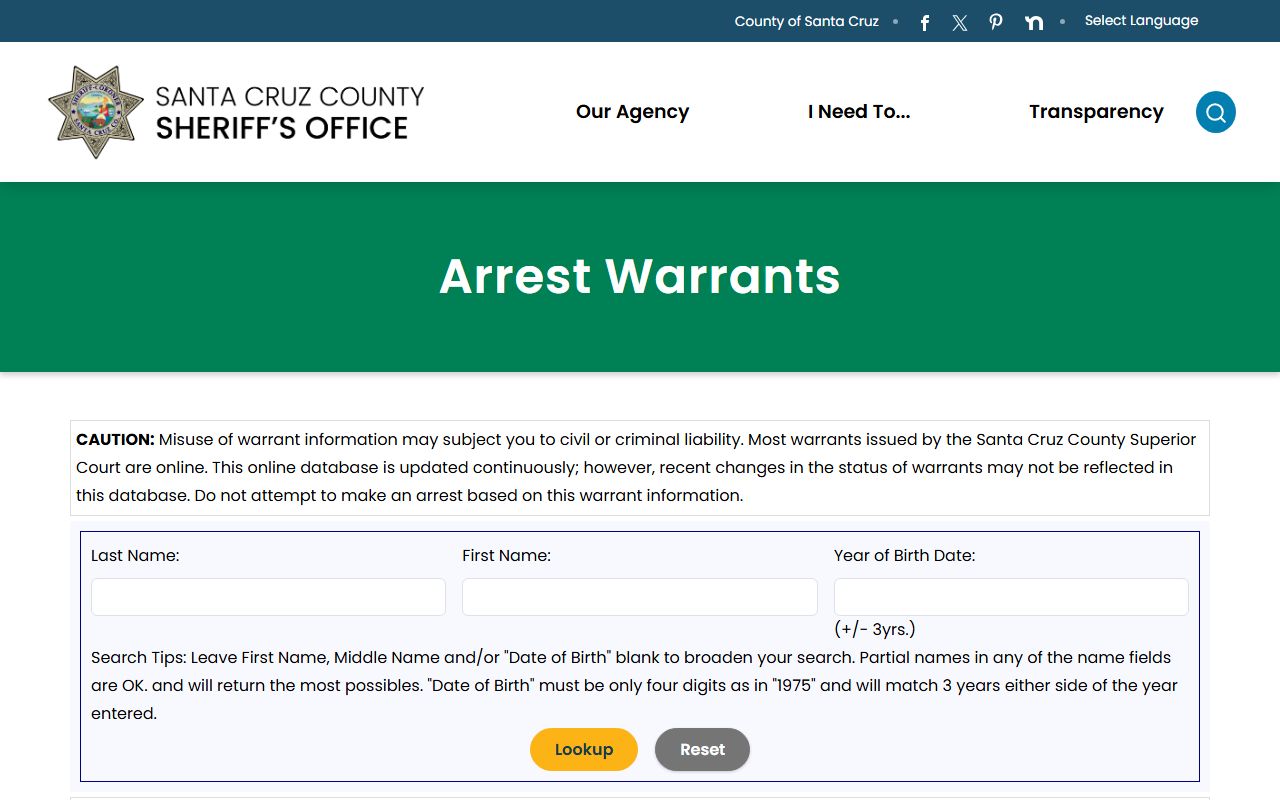
To search, enter the person's last name and first name. The system will show any matching warrants. Results include the case number, the charge, and the bail amount. If no warrant appears, that's a good sign. But the database may not be 100% complete. For official confirmation, call the Sheriff's Office at (831) 471-1121.
The online tool runs 24/7. You can check for warrants any time of day. This is useful if you want to find out quickly without going to the courthouse. But remember that warrant databases get updated regularly. A brand new warrant may not appear right away. Give it a day or two for the system to catch up in Santa Cruz County.
Sheriff's Office
The Santa Cruz County Sheriff's Office maintains warrant records and serves warrants throughout the county. The main office is at 259 Water Street in Santa Cruz. For warrant questions, call (831) 471-1121. Staff can look up warrant information and tell you what to do next.
If you have a warrant, you can turn yourself in at the Sheriff's Office. Bring valid photo ID. Tell the front desk you have a warrant and want to address it. Depending on the warrant type and bail amount, you may be arrested and booked, or you may be cited and released with a court date. High-bail warrants usually require booking into the jail.
The Sheriff serves warrants across Santa Cruz County. Deputies can arrest you at home, at work, or anywhere they find you. If you know you have a warrant, it's better to turn yourself in. Your cooperation gets noted in the records. This can help when you go before the judge in Santa Cruz County.
Superior Court Locations
The Santa Cruz County Superior Court has two main locations. The Santa Cruz courthouse is at 701 Ocean Street in Santa Cruz. The Watsonville courthouse is at 1 Second Street in Watsonville. Most criminal cases file at the Santa Cruz location, but some file in Watsonville depending on where the charges originated.
If you want to clear a warrant, contact the criminal division. The clerk can look up your case and tell you the next court date. They can also tell you the bail amount. The criminal division phone is (831) 420-2200. Call during business hours Monday through Friday.
Many people with bench warrants can appear at the courthouse in the morning and get seen the same day. Arrive early, before 8:30 AM. Go to the criminal clerk's office and tell them you have a warrant. They'll give you instructions. You'll wait for your case to be called in court. The judge will address your warrant and set a new date for your case in Santa Cruz County.
Court hours are Monday through Friday, 8:00 AM to 4:00 PM. The clerk's office may close for lunch from noon to 1:00 PM. Get there early if you need help the same day. Afternoons can be busy. Parking is available near both courthouses, but it can fill up on busy days in Santa Cruz County.
Common Warrant Types
Santa Cruz County issues several types of warrants. The most common is the bench warrant. Judges issue bench warrants when you fail to appear in court. This happens all the time. You miss a court date, the judge issues a warrant. Penal Code 978.5 covers bench warrant procedures in California.
Traffic warrants are a big category. If you got a ticket and didn't show up for court or didn't pay the fine, there's likely a warrant. Vehicle Code 40508 makes it a misdemeanor to fail to appear on a traffic citation. Santa Cruz County issues many traffic warrants each year. These usually have lower bail, often $200 to $500.
Arrest warrants come from criminal investigations. A judge signs an arrest warrant when there's probable cause you committed a crime. Probable cause means a reasonable belief based on evidence. Arrest warrants let police take you into custody. Bail can be high. Some serious charges have no bail at all. You must see a judge before you can be released in Santa Cruz County.
Search warrants are for property searches. Police get these to search homes, cars, or businesses for evidence. The public doesn't deal with search warrants directly. They're part of investigations. Judges review search warrant requests to make sure there's probable cause. If approved, officers execute the search and collect evidence in Santa Cruz County.
How to Clear Your Warrant
If you find out you have a warrant in Santa Cruz County, you have a few options. You can turn yourself in to law enforcement. You can post bail if the warrant allows it. Or you can hire a lawyer to help recall the warrant.
Turning yourself in means going to the Sheriff's Office or a police station. Bring your ID and be honest about the warrant. They'll run your name and confirm it. Then they'll either book you into jail or cite you out with a court date. It depends on the warrant type and bail amount. Most bench warrants with reasonable bail allow citation release in Santa Cruz County.
Posting bail clears the warrant and gets you a court date. You can post bail at the jail or the courthouse. Santa Cruz County accepts cash, money orders, and credit cards. The amount depends on the bail schedule or what the judge set. Traffic warrants might be a few hundred dollars. Felony warrants can be thousands or more.
A lawyer can file a motion to quash and recall the warrant. This is allowed under Penal Code 166. The lawyer asks the judge to remove the warrant. If the judge agrees, you don't have to be arrested. You just get a new court date. This works best if you had a good reason for missing court in Santa Cruz County.
Costs and Fees
Clearing a warrant in Santa Cruz County involves costs. Bail is the biggest expense. Amounts vary widely. A traffic warrant might be $250. A misdemeanor could be $2,500. A felony can be $25,000 or higher. Some warrants say "no bail" which means you can't pay to get out until you see a judge.
Court fees also apply. If you appear on a warrant, the judge may add a warrant fee to your case costs. This is usually around $150. The fee covers the administrative cost of issuing the warrant. Some judges waive it if you show good cause for missing court in Santa Cruz County.
If you need court records, copies cost $0.50 per page. Certified copies are $40.00 plus the per-page fee. If the clerk searches for more than 10 minutes, there's a $15.00 research fee. These are standard California Superior Court fees that apply in Santa Cruz County too.
Hiring a lawyer costs money. Criminal defense attorneys charge by the hour or a flat fee per case. A simple warrant recall might be $500 to $1,500. Complex cases cost more. Many lawyers offer free consultations. You can call and ask basic questions about your warrant situation before you hire anyone in Santa Cruz County.
Legal Help
A lawyer can make a big difference when you have a warrant. An attorney knows the court system and can advise you on the best approach. Some warrants can be recalled without you having to appear in person. This requires filing the right motions. A lawyer knows how to do this.
The Santa Cruz County Bar Association has a lawyer referral service. Call (831) 425-4755 to get connected with local attorneys who handle criminal cases. Most offer a free or low-cost initial consultation. Use this time to explain your warrant situation and get advice on next steps in Santa Cruz County.
If you can't afford a private lawyer, contact Legal Aid. Legal Services for Seniors provides free help to those who qualify. Call (831) 426-7322. They focus on seniors but may refer others to appropriate resources. Another option is the Lawyer Referral & Information Service which can connect you to attorneys who offer payment plans.
The court self-help center has forms and general information. Staff can't give legal advice, but they can help you fill out paperwork. The self-help center is at the Santa Cruz courthouse. Bring all your court documents. Staff can help you figure out what forms you need for your warrant case in Santa Cruz County.
Cities in Santa Cruz County
Santa Cruz County has no cities with population over 100,000. The largest cities are Santa Cruz with about 65,000 people and Watsonville with about 54,000. Other cities include Scotts Valley, Capitola, and several small coastal towns.
All cities in Santa Cruz County fall under the Superior Court jurisdiction. Your case location depends on where charges were filed. Most cases file at the Santa Cruz courthouse, but some file in Watsonville. Check your paperwork or call the court to find out which location handles your warrant in Santa Cruz County.
Nearby Counties
Santa Cruz County borders several other California counties on the central coast and in the Bay Area. Each has its own court system and warrant procedures.
- Santa Clara County to the north and east
- San Mateo County to the north across the mountains
- San Benito County to the east
- Monterey County to the south
Warrants from one county don't automatically transfer to another, but California has a statewide warrant system. If you have a warrant in Santa Cruz County and get stopped in Monterey County, that officer can see it. You could be arrested anywhere in the state on a Santa Cruz warrant. This is why it's important to clear warrants promptly.